
Advent

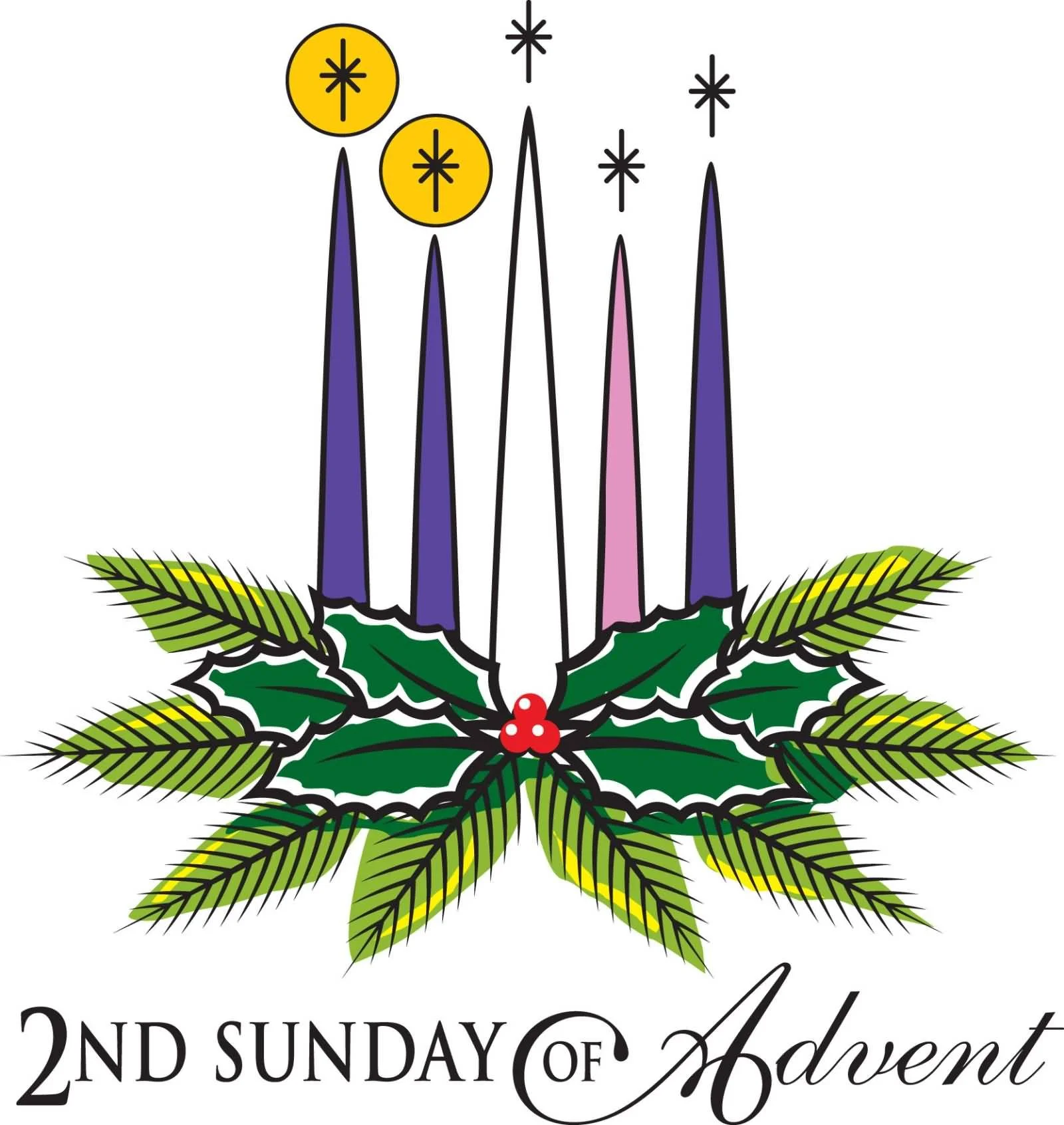
Second Sunday of Advent

At the beginning of the year, Pope Francis opened the Jubilee Door to the pilgrims of the world to begin a Jubilee Year of Hope.   

Today on this Second Sunday of Advent, St. Paul’s letter to the Romans 15:4-9 focuses our attention on Hope.  The reading explains how the early patriarchs adhered to Scripture.  The Scriptures encouraged them to be steadfast in their faith so that they “might have hope”.  They lived their lives hoping for a promised Messiah who would bring them lasting peace. 

In Matthew’s Gospel, John the Baptist is roaring in the wilderness “You brood of vipers. . . bear fruit worthy of repentance,” when he sees the Pharisees and the Sadducees coming to him.  John, the last of the ancient prophets, proclaims that the one who is to come will baptize “with the Holy Spirit and with fire”. 

Jesus was the fulfillment of the promises given to the patriarchs.  Jesus came so that now we might live in harmony and praise the Father of our Lord Jesus Christ with one voice. 

We are not there yet. 

We still need “hope”, an energy that keeps us consciously engaged, alive and moving forward and at the same time keeps us patiently waiting, desiring, and longing.  For what?  Do we even know? 

To live energized by hope and love could be the fire that makes us one earthly family, living in peace and harmony desiring the good of the other and sacrificing whatever it takes to sustain that “peace on Earth to all people of goodwill”.  May our human family soon turn to Jesus, the Way, the Truth and the Life. 

Teilhard de Chardin’s life discoveries considers love and hope as necessary energies moving the cosmos forward to greater consciousness and unity. 

Hope is a reminder that a longing/desire has not yet been realized.  Therefore, like Teihard we can agree that hope is an energy and that it keeps us consciously engaged, alive, and moving forward. 

Years ago, Henri Nouwen gave a series of meditations on The Spirituality of Waiting and showed how all the people in the first two chapters of Luke’s Gospel were waiting in Hope—Zacharia, Elizabeth, Mary, Joseph, Anna, Simeon.  

Jesus has fulfilled the promises given to the patriarchs.  Jesus came so that now we might live in harmony and praise the Father of our Lord Jesus Christ with one voice.   

We are not there yet.  We still live in hope.  During this season of Advent we are waiting, we are practicing living in hope by waiting in hope that someday soon we might live in harmony and praise the Father of our Lord Jesus Christ with one voice. 

-Sister Elaine Cole, csj

Images: wisconsinpictures/Unsplash

ADVENT: A Time to Lighten Up!

On these dark November days, I have been thanking God for glorious sunrises, stargazing, Northern lights, and supermoons.  This time of year, world religions celebrate Festivals of Light.  For Christians, in this Advent season, we anticipate the celebration of the birth of Christ who is “the true light, the Light of the World.”  In the beautiful prologue to John’s Gospel, we read: “The Light shines in the darkness, and the darkness did not overcome it.” 

The theme of darkness is a common thread running through the course of our lives. Darkness is a rich symbol in our spiritual life inviting us to grow and embrace our vulnerability.  In her book “Radical Amazement”, Judy Cannato proclaims: “Life is a Mystery, shrouded in darkness.  But the darkness is a place of possibility and power” leading to transformation.  Even our body was formed in the darkness of our mother’s womb.  When we were born, we passed from darkness into light.  In fact, I was born on the Winter Solstice: Light and darkness are part of who I am.  Since birth, I have had an inoperable cataract which means that while I have vision in my left eye, I cannot see with my right eye.  I was given the precious gift of sight and light and not total blindness and darkness.  

Whether a firefly, a flashlight, a porchlight, a bonfire, a fireplace, Christmas lights or Advent candles, we are drawn to the light.  It brings comfort, penetrating our wounds.  We can be sparks of light bringing hope to each other in the storms of life.  Within us we carry our greatest treasure, the Christ-light.  May we experience anew the Presence of the Cosmic Christ illuminating all of Creation. This Advent 2025, welcome the Light!  Be the Light!

-Sister Kathleen O’Keefe, CSJ

Image: Waldemar Brandt/Paolo Nicolello/Unsplash

The Hidden Light of Advent

Each Year as Advent approaches, I and others promise ourselves additional moments of quiet reflection to anchor Bethlehem’s gift into the ordinariness of the daily. As usual the obligations of the daily unfold, and moments of joy become added, as we celebrate Christmas (a bit early) with those with whom we live, meet and work. Often there is a trip to the mall, and we know for certain that upon departure we will hear echoed, “have a holly, jolly, Christmas, this year.” The days slip by.

It is not surprising that the Liturgy tries to recapture our attention with the beginning of  the “O Antiphons of Advent” on December 17th .  These antiphons will be with us until December 23rd. At first glance, we recognize that each of the seven is an attribute of the Child to be born in Bethlehem. For example, “O Wisdom” celebrates the creative and creating Word of God - a celebration and a hope/longing for truth/justice/peace to reign. We are conscious of the hunger of a world that cries for wholeness and seeks to acquire it- often by force.  As we probe the meaning of each of the antiphons, we find both an attribute of Bethlehem’s Child and an existential challenge.  “O Rising Sun” offers a supplication to God to intervene in the chaos we have created.  We seek justice, for peoples, for nations, for the poor, for families, for war-torn lands. Our exploration of the Great “Os” and their significance in our daily lives continues until December 23rd.

Our readings for the 4th Sunday of Advent continue our preparation for Christmas.  Micah (5:2-5a) notes that the ruler of Israel is from Bethlehem and that people will live secure and that “he” shall be peace. The second reading, from Hebrews. posits that Christ abolishes the offerings dictated by law and simply states “I have come to do your will.” The author notes that “it is by God’s will that we have been sanctified through the offering of the body of Jesus Christ once for all.”  (Hebrews 10:5-10). The gospel reading from Luke (1:39-45) recounts Mary’s travel to Ein Karem to greet her cousin Elizabeth who exclaims “as soon as I heard the sound of your greeting, the child in my womb leapt for joy.”  Undoubtedly this visit is linked to Mary’s earlier “fiat”. On the surface there is a warm greeting between cousins. However, travelling in the first century was not a simple task. The journey from Nazareth to Judea would take at least four days on foot or donkey. Often people travelled by Caravan. A woman, particularly a young unmarried girl, travelling alone leaves herself open to charges of shameful conduct. Luke brings together these two Mothers-to-be to recognize and celebrate the God who is so entwined in their lives and subsequently in the lives of their children.

On December 25th, the Birth of the Babe in Bethlehem underscores our belief that God is with us – yesterday, today, and tomorrow. On December 26th we walk confidently forward amid the graces and challenges of our time to gift 2025 with the love of neighbour, the CSJ Charism.

-Sister Anne Anderson, CSJ

Image: Greyson Joralemon; Max Beck | Unsplash

THIRD SUNDAY OF ADVENT

With the approach of the third Sunday of Advent, I have been reflecting on the African practice of ubuntu. You may wonder, what is ubuntu?  Author, Mungi Ngomane says, “If we are able to see ourselves in other people, our experience in the world will inevitably be a richer, kinder and more connected one. If we look at others and see ourselves reflected back, we inevitably treat people better. In a nutshell. It recognizes the inner worth of every human being starting with yourself.”

Today, in Luke’s Gospel account, John the Baptist is shedding light on the practice of ubuntu which involves love of neighbor, love of self, honesty, charity etc. In the gospel scene, John is speaking to a crowd of diverse people. Some are seekers, others simply curious, some are soldiers and others tax collectors. On a few occasions, these characters ask John a question, “What should we do?”  His terse reply urges them to change their lives. Like ubuntu-living, John invites the crowd to embrace a shapeshifting call for justice-making and of giving away as much as possible so that everyone has enough to live on. These life-giving practices are what ubuntu and John’s message proclaim to a world so in need of self-love which then can pour out on the neighbor. Hopefully, appreciation and love will be reflected to the giver. 

Image: Jeremy Bishop/Unsplash

All of us have had experiences of holding up a light for another human being. Like John, paving the way forward for the Light to come, we continue our journey of living mystery and tending to the emergent so that generations to come may live in peace, harmony, and justice-making.

Remember, John’s questioners asked, “What can we do?”  There is always much we can do!  It is most often in least expected ways.  I am reminded of a quote from the Quran. “Whoever saves a human life shall be regarded as though they had saved all humankind.” Wow! The smallest act of love might be that one lifesaving gesture for someone sitting or standing in front of you! This is indeed ubuntu in action!

-Sister Linda Parent, CSJ

Reflecting on the Second Sunday of Advent

“God has done great things for us…” (Psalm 126)

“Prepare the way …Every valley shall be filled… the rough ways made smooth...” (Luke 3)

The Second Sunday of Advent strengthens our longing for the God of Peace to come swiftly to our shattered world, bringing compassion and light to many troubled areas: Ukraine, Russia, Gaza, Israel, Lebanon, Syria, etc. Would we not surrender our petty grievances if peace could be had in the devastated areas of our world, in the troubled hearts of the lonely and addicted, in the trauma of those burdened by homelessness and financial concerns? How we long to reconcile Conservatives and Liberals, Democrats and Republicans. Can we open our hearts wide enough to seek understanding without judgment?

We ask God to restore the fortunes of those despondent who worry like watercourses in the desert. Can weeping be turned into carrying and sharing of sheaves?

Healing hearts and lives, and divisions within and between countries are the crooked ways that need straightening out and uneven ground that requires leveling. Such acts are the great things that God longs to do for our world.

As we immerse ourselves in the purple of Advent, may we walk with the people in our troubled cities and world; may we claim the pain that is within our own minds and hearts and lift it to the light, safety and compassion of God’s presence. As the writer of Philippians was confident that the one who began a good work among you will bring it to completion by the day of Christ Jesus,” may we claim with confidence God’s compassionate presence and healing, both for ourselves and for our world.

Our country and the world are not broken; we need to rediscover and believe God’s promise of ongoing presence living in our hearts. We need to claim the strength, hope and commitment to prepare the way of God in our world today- an important task and not one done alone.

“… teach us, O God, to judge wisely the things of earth….”    (Prayer after Communion)

-Sister Helen Russell, CSJ

Images: Grant Whitty @grantwhitty/ Kelly Sikkema @kellysikkema Unsplash